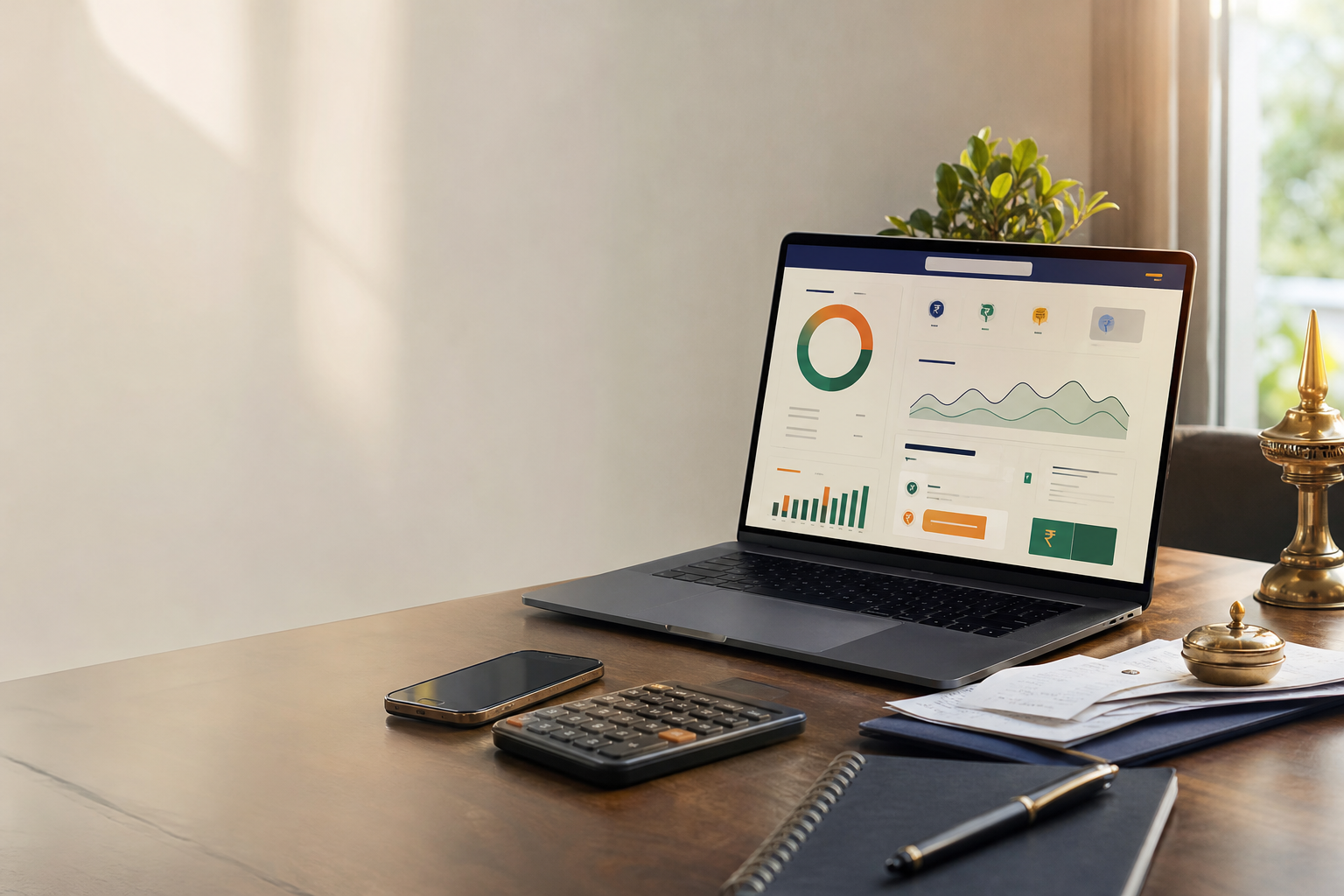
How AsliBooks Simplifies Business Accounting for Indian Businesses
Learn how AsliBooks helps Indian small businesses manage GST-ready invoicing, purchases, expenses, payments, double-entry accounting, and financial reports in one cloud-based system.
Aslisite Team
Digital Experts
Table of Contents
What makes business accounting difficult?
How AsliBooks simplifies business accounting
1. It brings billing and accounting together
2. GST-aware workflows reduce avoidable errors
3. Payment tracking gives owners a clearer cash position
4. Credit notes and debit notes stay connected to the books
5. Double-entry accounting works behind everyday transactions
6. Financial reports turn transactions into useful information
7. Cloud access supports a more flexible routine
What does the day-to-day workflow look like?
AsliBooks compared with other accounting options
1. Zoho Books: strong cloud accounting and broader business features
2. TallyPrime: established accounting for detailed business operations
3. BUSY: useful for GST, inventory, and MSME workflows
4. AsliBooks: focused accounting for Indian small businesses
5. ClearOne: billing and GST-oriented tools
Who can benefit most from AsliBooks?
How to get better results from any accounting software
Final takeaway
Small-business accounting becomes difficult when invoices, purchase bills, expenses, customer payments, vendor dues, and GST records are maintained in separate places. AsliBooks simplifies this work by bringing everyday billing and core accounting into one cloud-based, GST-ready system for Indian businesses.
Instead of treating invoicing as a standalone task, AsliBooks connects routine business entries with proper accounting records. This gives business owners a clearer view of what they have sold, what they owe, what customers owe them, and how the business is performing.
What makes business accounting difficult?
Many small businesses start with spreadsheets, notebooks, messaging apps, and separate billing tools. That approach may work for a small number of transactions, but problems appear as the business grows:
- Sales invoices are created but not properly reflected in the accounts.
- Purchase bills and expenses are recorded late or forgotten.
- Customer and vendor payment status is difficult to track.
- Credit notes and debit notes are handled manually.
- GST-related sales and purchase information needs repeated checking.
- Profit and loss figures are available only after an accountant prepares them.
- Business owners cannot quickly connect daily transactions with financial reports.
The real issue is not only data entry. It is the lack of a consistent flow from transaction to accounting record to business report. AsliBooks is designed to make that flow easier to manage.
How AsliBooks simplifies business accounting
1. It brings billing and accounting together
AsliBooks supports customers, vendors, items, sales invoices, purchase bills, expenses, and payment tracking in the same system. This reduces the need to maintain separate lists for billing and bookkeeping.
For example, a small trading business can maintain its customer and vendor records, create a sales invoice, record a related purchase bill, enter business expenses, and track payments from one accounting workspace. The business owner does not have to rebuild the same information later in a separate ledger or spreadsheet.
2. GST-aware workflows reduce avoidable errors
GST accounting becomes easier when sales and purchases are recorded with GST requirements in mind from the beginning. AsliBooks provides GST-ready invoicing and GST-aware sales and purchase workflows, helping businesses maintain more organised transaction records.
This is useful for businesses that issue taxable invoices, record purchases from vendors, and need their sales and purchase information to remain consistent with their books. It also gives the business a more structured starting point for reviewing GST-related records with an accountant or tax professional.
GST software does not replace the need to apply the correct tax treatment. Businesses still need to verify GST rates, place-of-supply details, invoice information, and filing requirements based on their transactions. The benefit is that the underlying records are maintained in a more accounting-friendly format.
For a broader overview of selection criteria, see this guide to GST accounting software for small businesses in India.
3. Payment tracking gives owners a clearer cash position
Revenue shown on an invoice is not the same as cash received. A business can have strong sales and still face pressure if customer payments are delayed.
AsliBooks includes payment tracking for business transactions. This helps owners review which customer invoices have been paid, which remain outstanding, and how vendor payments are progressing. A simple payment review can support better follow-up and reduce the risk of relying on memory or scattered messages.
Consider a service provider with ten active customers. Without payment tracking, the owner may need to search through bank records and chat messages to identify unpaid invoices. With properly maintained invoice and payment records, the outstanding position can be reviewed as part of the accounting workflow.
4. Credit notes and debit notes stay connected to the books
Returns, price adjustments, billing corrections, and additional charges can make accounting confusing when they are handled outside the main system. AsliBooks supports credit notes and debit notes, allowing businesses to record these adjustments more systematically.
This matters because a corrected transaction should not simply disappear from the records. The original invoice, adjustment, and resulting customer or vendor balance should remain understandable when the accounts are reviewed later.
5. Double-entry accounting works behind everyday transactions
Many business owners want simple billing, but they also need reliable books. AsliBooks supports double-entry accounting, a chart of accounts, journal entries, and the general ledger.
These accounting foundations help organise transactions under appropriate accounts rather than treating every entry as an isolated invoice or payment. A business can therefore move from basic billing to more structured bookkeeping without maintaining an entirely separate accounting system.
The chart of accounts also gives the business a framework for classifying income, expenses, assets, liabilities, and other financial activity. A well-organised chart makes reports easier to understand and gives accountants cleaner records to review.
6. Financial reports turn transactions into useful information
Recording transactions is only valuable if the business can use the information. AsliBooks provides a trial balance, profit and loss statement, balance sheet, general ledger, banking records, and business reports.
These reports help answer practical questions:
- Is the business making a profit during the selected period?
- Which expenses are increasing?
- Are customer receivables becoming too high?
- What liabilities and balances need attention?
- Do the books appear balanced and complete?
- What information should be discussed with the accountant?
A profit and loss statement can show operating performance, while a balance sheet provides a view of assets, liabilities, and equity. The trial balance and general ledger help users investigate how those figures were formed.
7. Cloud access supports a more flexible routine
Because AsliBooks is cloud-based, business records can be managed through an online accounting system rather than being tied to a single paper file or computer. This can be useful when the owner, accounts staff, and external accountant work from different locations.
Cloud access does not remove the need for good user access practices, backups, and regular review. It does, however, make it easier to keep the accounting work in one shared system instead of passing files back and forth.
What does the day-to-day workflow look like?
A practical AsliBooks workflow may look like this:
- Add customers, vendors, and items used by the business.
- Create sales invoices for goods or services supplied.
- Record purchase bills received from vendors.
- Enter operating expenses such as rent, transport, utilities, or professional services.
- Track payments against customer invoices and vendor bills.
- Record credit notes or debit notes when transactions need adjustment.
- Review the general ledger, trial balance, profit and loss, and balance sheet.
- Use business reports to identify balances or transactions that need attention.
The advantage is consistency. Each transaction has a place, and the business can move from daily entries to financial review without rebuilding the records manually.
AsliBooks compared with other accounting options
AsliBooks is not the only accounting product available to Indian businesses. The right choice depends on the complexity of the business, the preferred working style, GST requirements, reporting needs, and the level of inventory or operational control required.
1. Zoho Books: strong cloud accounting and broader business features
Zoho Books is a cloud accounting platform with GST reports, invoicing, bills, expenses, inventory-related features, banking and reconciliation, payment reminders, and multiple reporting options. Its higher plans add features such as projects, approvals, payroll, advanced inventory, and analytics.
Best fit: Businesses that want accounting connected to a wider suite of business applications and are comfortable choosing between multiple subscription plans.
Trade-off: The breadth of features can mean more setup and plan comparison than a small business needs at the beginning.
2. TallyPrime: established accounting for detailed business operations
TallyPrime covers accounting, invoicing, inventory, banking, GST, business reports, and other operational requirements. It is widely used by Indian businesses and accountants that need detailed configuration and established accounting workflows.
Best fit: Businesses that need mature accounting, inventory, compliance, customisation, or multi-user options.
Trade-off: New users may need more training and configuration, especially when the business only needs straightforward cloud bookkeeping.
3. BUSY: useful for GST, inventory, and MSME workflows
BUSY combines billing, accounting, GST, inventory, receivables, payables, and business reports. Its current plans range from basic billing and accounting to editions with GST reconciliation, e-invoicing, e-way bills, multiple branches, and additional controls.
Best fit: Trading, distribution, retail, and other growing businesses that need inventory and GST capabilities alongside accounting.
Trade-off: Businesses with simple service billing may not need the full breadth of inventory and operational features.
4. AsliBooks: focused accounting for Indian small businesses
AsliBooks is Aslisite's own accounting and GST-ready business software. Its verified scope covers customers, vendors, items, sales invoices, purchase bills, expenses, payment tracking, credit notes, debit notes, double-entry accounting, journals, the chart of accounts, the general ledger, trial balance, profit and loss, balance sheet, banking records, GST-aware workflows, and business reports.
Best fit: Small Indian businesses that want a focused cloud accounting system connecting GST-ready billing with proper books and core financial reports.
Trade-off: Businesses looking for advanced inventory control, payroll, project management, extensive integrations, or complex multi-branch operations should confirm whether their required workflows are supported before switching.
5. ClearOne: billing and GST-oriented tools
ClearOne focuses on GST billing, invoicing, stock management, and related tools for small businesses. It may suit businesses that primarily need billing and GST-oriented workflows, particularly when those needs are more important than a broad accounting ledger.
Best fit: Small businesses that want a billing-led GST solution and may use separate accounting support for deeper bookkeeping.
Trade-off: Compare the accounting depth, reporting structure, and day-to-day bookkeeping workflow carefully if you need more than invoicing and stock records.
Who can benefit most from AsliBooks?
AsliBooks may be a practical fit for:
- Small retailers and traders managing regular sales and purchases.
- Service businesses that need invoices, expenses, payment records, and financial statements.
- Early-stage businesses setting up structured books from the beginning.
- Owners who want GST-ready invoicing connected to accounting records.
- Businesses moving away from spreadsheets or disconnected billing tools.
- Teams that need a shared cloud-based place for routine accounting work.
It may be less suitable if your operation depends on specialised manufacturing, advanced warehouse controls, payroll, project costing, or complex enterprise integrations. In those cases, a broader ERP or accounting platform may be a better match.
How to get better results from any accounting software
Software can organise accounting, but the quality of the reports still depends on the quality of the entries. Before getting started, define a sensible chart of accounts, enter complete customer and vendor details, record transactions regularly, and review outstanding payments at a fixed interval.
It is also useful to agree on a simple process for handling corrections. Do not delete or ignore a transaction simply because it needs adjustment. Use the appropriate credit note, debit note, journal entry, or other accounting treatment and retain supporting records.
For businesses comparing cloud tools, this guide to cloud accounting software for small businesses in India provides additional questions to consider before choosing a platform.
Final takeaway
AsliBooks simplifies business accounting by connecting the work small-business owners already do—selling, purchasing, spending, receiving payments, and paying vendors—with structured accounting records and financial reports.
Its main value is not just creating invoices. It helps businesses maintain a clearer accounting trail from GST-aware transactions to ledgers, trial balance, profit and loss, and balance sheet reporting. For Indian small businesses that want focused cloud accounting without managing separate billing and bookkeeping systems, AsliBooks can provide a more organised way to run the accounts.
Ready to scale your digital presence?
Join businesses growing with Aslisite. Let's discuss your project today.